14/02/2016
Barefoot Running: Is it right for me?
Barefoot running has been a hot topic over the last 10 years and has in part, polarised the running community. Searching the web reveals as many testimonials from both ends of the spectrum. There are as many who claim that running without shoes is the panacea for all running injuries as there are that it is worse than commiting yourself to a life of pain. Both views have some fact, but the extreme opinions don't really align with what current reasearch tells us.
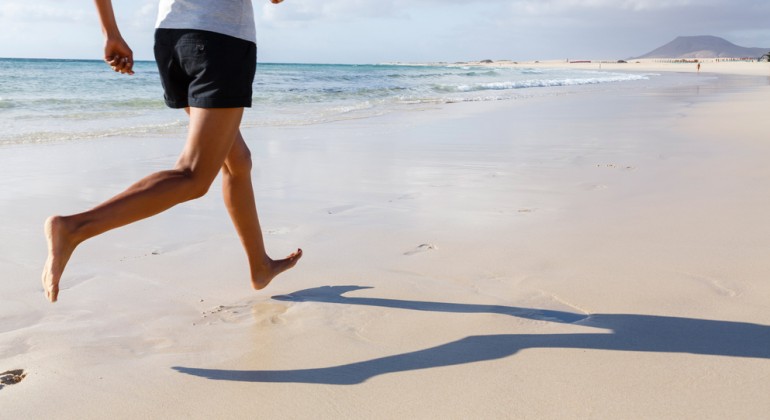
It is now univerally accepted that running in shoes is different to running in bare feet, and that one of the primary differences is in how we land. In bare feet we consistently land on our forefoot, whereas in shoes about 75% of us land on our heels (Hasewaga et al 2007). Additionally, landing on our heels increases the amount of shock that passes through our lower limb, increasing both the load through our knees and tendency to over-pronate. Despite the biomechanical data pointing to barefoot running being potentially better for us, there remains very little research to prove it.
What we do know is:
- Barefoot running produces a shorter stride and increased cadence.
- Biomechanical modelling has shown that a 10% reduction in stride length has protective effects against tibial stress fractures.
- Barefoot running increases the loads absorbed through the calf and adjacent muscle groups, requiring greater calf strength.
- Barefoot running is not toe running.
- Barefoot running may increase the load through the bones in the front of our feet (metatarsals) and expose them to increased risk of stress fracture.
- Heelstrike running increases the load on the muscles of the front of the leg associated with "shin spllints".
- Changing landing patterns from heelstrike to forefoot landing has been shown to improve shin pain.
- Running in minimalist shoes is not the same as running in barefeet and in fact, not significantly different to running in traditional running shoes (Bonacci et al 2013).
So the question remains, is barefoot running right for me. The answer is maybe. There are many factors that need to be considered and like most things, any new activity needs to be built up gradually. Running in barefeet will change how you run. Your Achilles and feet will take at least 12 weeks to adapt to the new loads and you will need to reduce your running volume during this time. Remember, start slowly and build up gradually.
If you are unsure as to whether barefoot running is right for you, feel free to call and discuss it with us.